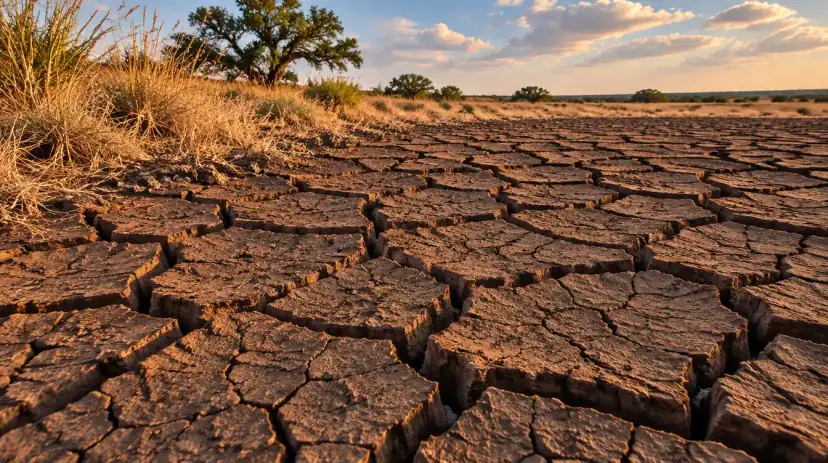
What shrink-swell soil is
The Texas Department of Licensing and Regulation published a technical bulletin on foundations on expansive soils (issued 2010, revised October 16, 2018). It says expansive soils shrink and swell with changes in moisture. At high moisture they heave, which can lift a building. At low moisture they collapse, and the building can settle. Both can cause extensive damage, it says. It also says the amount of swelling depends on the percentage and the type of clay.
The bulletin lists the International Residential Code test for expansive soil. A soil counts as expansive if it meets four conditions: a plasticity index of 15 or more, more than 10 percent of particles passing a No. 200 sieve, more than 10 percent of particles under 5 micrometers, and an expansion index above 20 (the expansion index test can stand in for the first three). We list the test only to show that "expansive" is measured, not guessed.
Houston Black: a clay soil mapped in Bexar County
The USDA publishes an official description of the Houston Black series, a deep clay soil from Texas. It says the soil is very slowly permeable and that, when dry, it has cracks 0.5 to 4 inches wide that reach 12 inches or more deep and stay open for 90 to 150 days in most years. It also says water enters the soil quickly when it is dry and cracked and very slowly when it is moist. The description puts the series in the Blackland Prairies and the eastern Grand Prairies of Texas. The series description does not map it. For that, we used the USDA Soil Data Access service, which serves the data behind the Web Soil Survey. In the Bexar County survey (area TX029, data last updated September 3, 2026) the Houston Black map units add up to about 89,000 of the roughly 804,600 acres mapped, about 11 percent of the county. By our tally of the same data, Eckrant is the largest soil by acreage, with Houston Black second and Lewisville third. For Houston Black clay, 1 to 3 percent slopes, the data lists 54 percent clay and a linear extensibility of 12 percent, the USDA measure of how much a soil can shrink and swell between moist and dry. Treat this as county-level context, not as a map of your street.
Bexar County is not one soil
A 2023 geologic assessment filed with the Texas Commission on Environmental Quality for a site in Helotes describes the soils there as Eckrant cobbly clay and Eckrant rock outcrop. It describes the Eckrant series as very shallow to shallow over limestone. That is the same county but a different setting from a deep clay plain. The assessment says it relied on the USDA Soil Survey of Bexar County through the web viewer. Source: TCEQ application file for the SAWS Los Reyes site, read November 6, 2026, for the soil description only. County acreage: USDA NRCS Soil Data Access, survey area TX029, read November 6, 2026.
How to look up your lot
The TDLR bulletin points to the USDA Web Soil Survey for soil reports and says engineering data for a county can be downloaded there. Type your address into the survey's map to see the soil units for your lot. We state nothing about any address. The survey is a general guide. It does not replace a soil test on your lot.
Questions to ask
- What soil is under my lot according to the Web Soil Survey, and does an engineer agree that it is expansive?
- Would the engineer order a soil test, or is the repair based only on a visual inspection?
- How does the proposed repair account for the soil moisture changes around my house? (See the moisture guide.)
Frequently asked questions
Is the soil under my house expansive clay?
We cannot tell. Soil changes from lot to lot and from the north of Bexar County to the south. Look up your address in the USDA Web Soil Survey and ask an engineer, who may order soil tests.
What is Houston Black clay?
A named clay soil series described by the USDA. Its official description calls it very deep, very slowly permeable, with clay that cracks when dry. It is a good example of how this kind of soil behaves. The USDA soil survey maps it in Bexar County, in about 89,000 acres, which is roughly 11 percent of the acres mapped in the county.
Is all of Bexar County clay?
No. A 2023 geologic assessment for a site in Helotes, in the northwest of the county, describes soils that are cobbly clay over limestone, very shallow to shallow. That is a different setting from deep clay.